
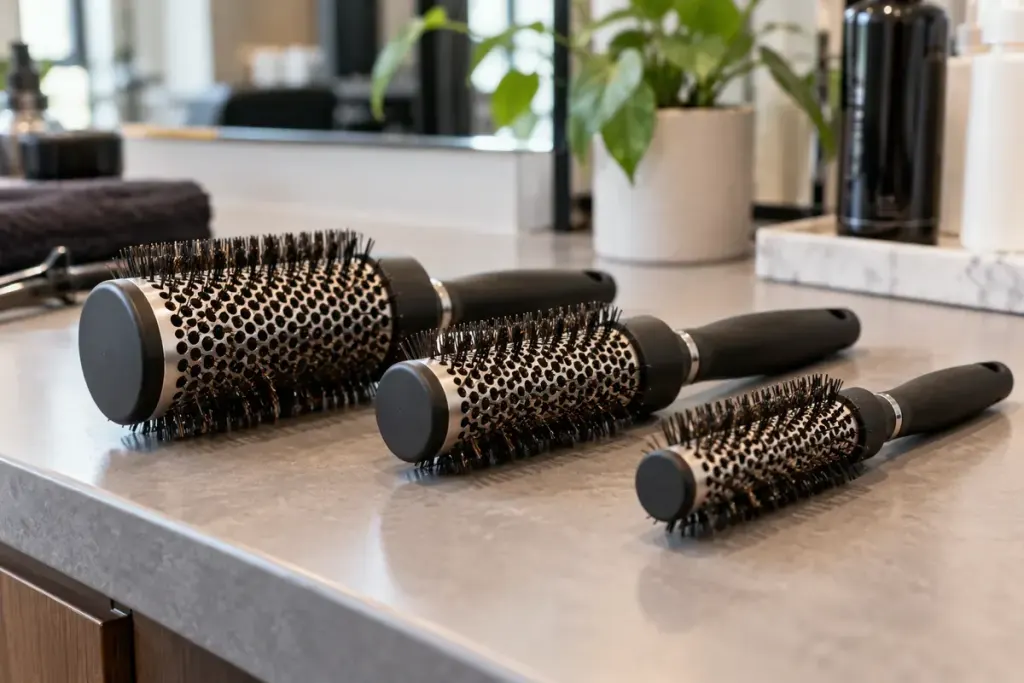
Two round brushes can look almost identical in a drawer yet produce quite different handling at the ends of your hair. The barrel diameter affects how much hair can wrap around it and the curve you are trying to create.
Start with the result: a gentle bend, more lift near a section’s base, or a more pronounced turn at the ends. Hair length, texture and the brush’s bristles matter alongside diameter. A large barrel that works well on longer hair may be awkward to position on a short section.
Practise the movement without heat
On a small, detangled section, check whether you can place and remove the brush smoothly. Avoid winding a long section repeatedly around the barrel as though more wraps must produce a better result. Tangling is a reason to stop, not pull harder.
Compare one section at a time with a brush you already know. Notice whether the barrel reaches the area you want to shape, whether the bristles grip comfortably and whether you can release the ends without snagging. These observations are more useful than choosing by the largest diameter on the shelf.
Follow the tool’s heat guidance and your hair-care needs. Keep the dryer moving appropriately and avoid pressing its hot nozzle against the brush or hair. A metal or ceramic barrel can become hot even when its handle feels comfortable.
Take a specific question to the salon
If you cannot reproduce a style, describe where the movement fails: the ends curl too tightly, the brush slips, or the section catches. Ask your stylist to demonstrate a suitable barrel size and section size on your actual hair.
Clean and inspect the brush as its maker recommends. Damaged bristles and trapped hair change how it handles. The right tool is the one you can use with controlled tension and a repeatable movement, rather than the one that promises the most dramatic transformation.