
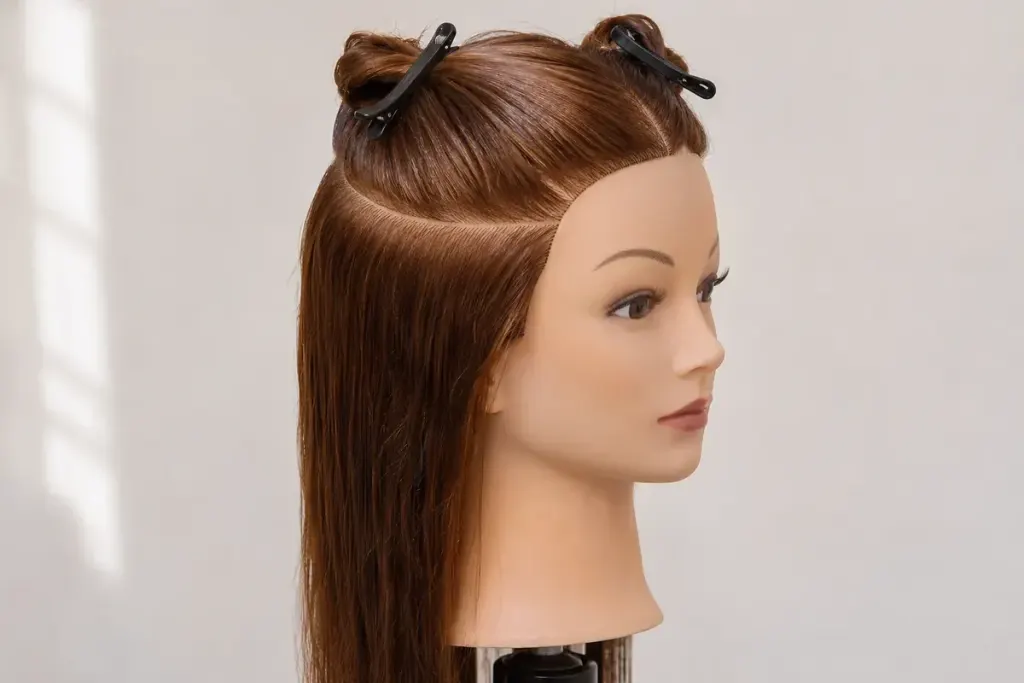
A curved parting around the upper head can make a haircut easier to organise. Often called a horseshoe section, it separates an area on top from hair below it so those areas can be handled with different intentions.
The section is a working boundary. It does not, by itself, prescribe how short the sides should be or how much length the top should keep.
Start with the purpose of the separation
In Sam Villa’s wolf-cut tutorial, a horseshoe section is part of the cutting plan. A forward-angled bob tutorial also uses organised sectioning to isolate areas. The same broad section name can therefore appear in quite different finished styles.
Before drawing the parting, identify the task: preserving top length, controlling weight, or keeping hair out of the way while another area is worked. The shape should support that task and the person’s head shape, density and growth pattern.
Check the section before cutting
For a student practising on a mannequin, comb the hair into its intended position and make the parting visible. Clip the separated area securely without dragging hair across the boundary. Look from the front, both sides and the back rather than assuming the curve is balanced from one viewpoint.
An illustrative practice exercise is to section, photograph and release the hair without cutting it. Repeat with a slightly different boundary and observe which hair moves into the top section. That makes the section’s effect easier to understand without committing to a length change.
Do not mistake a clip for a cutting guide
The guide, elevation, overdirection and connection between areas still need to be established by the cutting method. A clean horseshoe section cannot compensate for uncertainty about those decisions.
For a salon client, a useful question is: “Which length are you keeping on top, and how will it connect to the sides?” It directs the consultation toward the finished shape rather than a technical term. For a learner, practise the full method under suitable instruction before transferring it from a mannequin to a person.