
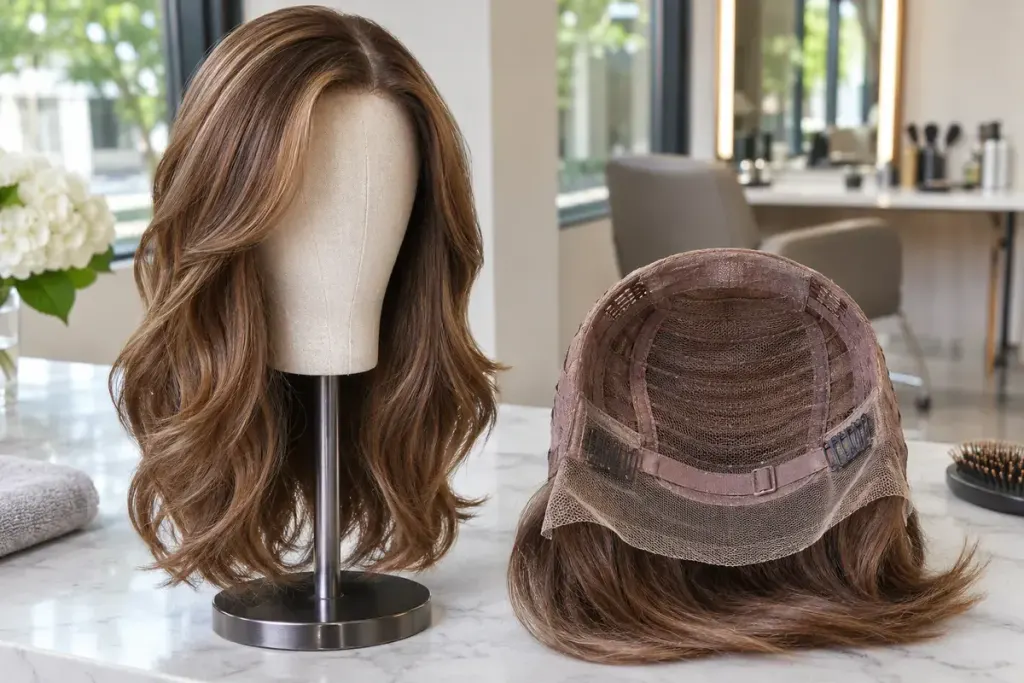
Two wigs can show a similar centre part in a product photograph while offering very different freedom to restyle it. Before choosing by colour and length, find out how the cap creates that parting.
A useful manufacturer comparison comes from Ellen Wille. Its Piemonte description lists a full monofilament top with flexible parting, while the Flirt description specifies a monofilament part. These are examples of distinct constructions, not a claim that every wig from the brand has the same features.
Separate the hairline from the parting
A lace front concerns the front hairline. It does not, by itself, tell you how much of the top can be parted in another direction. Read the complete cap specification rather than treating “lace” as shorthand for unlimited styling.
Think about your intended hairstyle in concrete terms. Do you want to tuck one side back, move a part several centimetres, or wear the fringe forward every day? Those questions are easier for a fitter to answer than “can it be styled?”
Ask to see the construction
Request a photograph of the inside cap and a demonstration of the proposed parting. Compare the same model, not another wig with a similar name. If shopping in person, ask the fitter to show what can be changed without damaging the fibre or cap.
- Record whether the top has a designated part or a wider flexible area.
- Check the fibre’s own care and heat instructions separately.
- Ask whether the pictured style required professional preparation.
- Keep the exact model and colour code with your notes.
A realistic decision might be to accept a fixed side part because you like that style and will keep it. Another buyer may value a broader monofilament area precisely because they want variation. Neither choice follows from a glamorous front photograph alone.
Cap construction turns a vague styling promise into something you can examine. Match that construction to your everyday hairstyle before committing to the cut you see on the screen.