
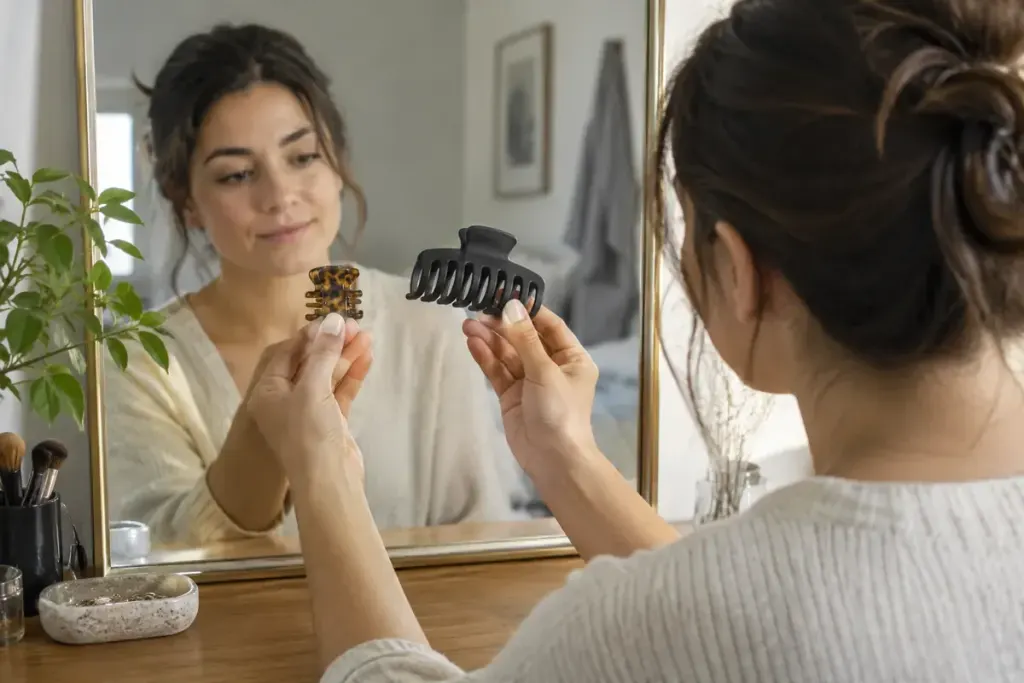
A clip slides out, so you gather more hair and fasten it more tightly. That may change the problem from slipping to pulling without creating a comfortable style. The accessory needs to suit the section it holds.
Compare the fastening with the amount and texture of hair involved. A small clip can struggle with a thick section, while a large claw may have little to grip in a narrow one. The number on a product label cannot fully describe that match.
Try a smaller adjustment
Change the section size or placement before adding tension. Test the style through ordinary movements: turning your head, looking down and putting on the clothing you will wear. Notice whether the accessory presses against the scalp or catches nearby strands.
Check the teeth, edges and hinge for damage. A rough join or broken tooth can snag hair even when the overall size seems right. Do not keep using a damaged fastening because it is the only one that holds a favourite style.
Plan the release as well as the hold
Remove the accessory gently and in the direction its mechanism allows. If hair is caught, pause and free the strands rather than pulling the whole clip away. A style that takes repeated force to undo may need a different tool or arrangement.
For ties, use a suitable product and avoid tightening solely to compensate for a poor fit. If a style hurts, loosen or remove it. Persistent scalp pain or unexpected hair loss should be discussed with a qualified clinician.
Keep a small selection that serves distinct jobs: perhaps one for a partial section and another for gathering more hair. You do not need a large collection to test the principle. The useful accessory holds the intended section comfortably and comes out without turning removal into another styling problem.