
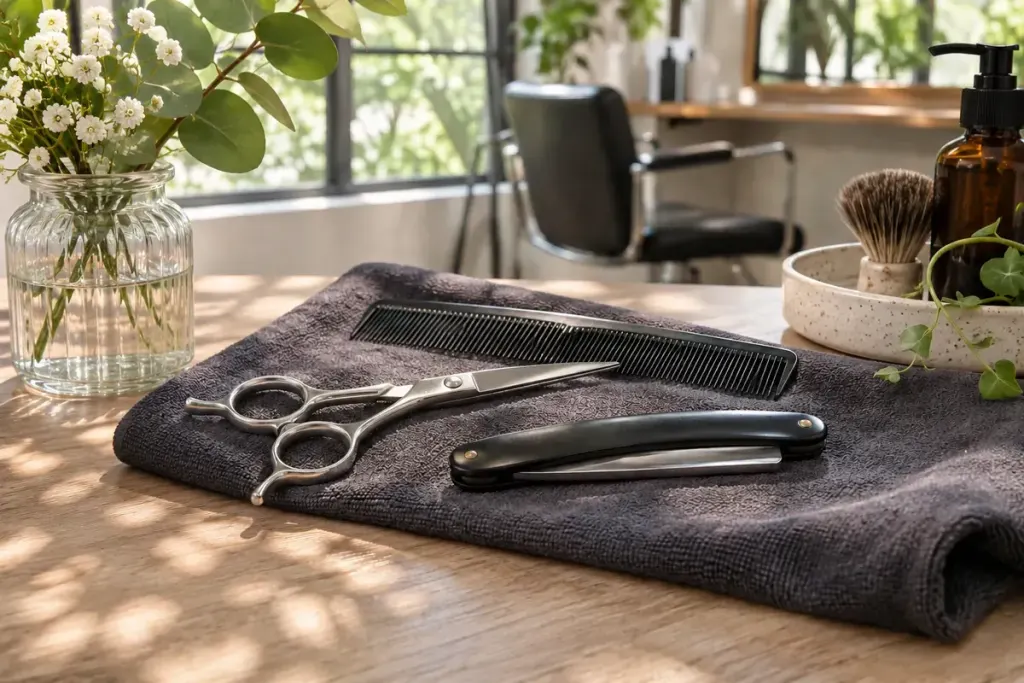
A razor haircut is not the same operation as shaving the scalp. In a stylist’s hands, the blade can work along selected hair to taper its ends and soften its surface. That offers a different way to shape the weight within a cut, but it is still removal: the hair taken away does not return when the styling is washed out.
Sam Villa’s guide to removing weight describes razor work as a way to reduce bulk and create a lighter perimeter. It also warns that repeated passes or excessive pressure can weaken the ends, particularly where hair is fragile. The tool’s name alone cannot tell you whether the proposed work suits your hair.
One blade, different applications
A razor service is not a single standard recipe. The section chosen, the direction of the work and the amount removed influence the result. An educator’s demonstration is useful when it explains those decisions instead of presenting the blade as an automatic shortcut to movement.
For example, Sam Villa’s twist-cutting demonstration uses a twisted section to loosen a blunt edge in coarse hair. The section is released so the resulting texture can be seen. This is a specific professional technique, not a reason to twist and shave random sections at home.
Watch the before-and-after part of such a demonstration closely. Does the exterior outline change, do the ends separate, or does an area become less dense? Naming the visible change helps you understand what the technique actually achieved.
Softness has a structural cost
Imagine a heavy bob that already has delicate ends from earlier chemical services. Making every edge more airy may work against the fullness the person wants to keep. A smaller targeted change, another method, or leaving the area alone may be the better professional decision.
Conditioning can improve handling and appearance, but it cannot replace strands removed during cutting. If the result becomes too sparse, adding another pass is not a reset. This is why a measured assessment matters more than the promise that a razor always produces an effortless finish.
Before agreeing to the service, ask the stylist to explain the purpose of the razor in this particular cut. A clear answer should connect the blade, the hair’s condition and the intended result. That explanation is more useful than treating “razor cut” as a complete style description.