
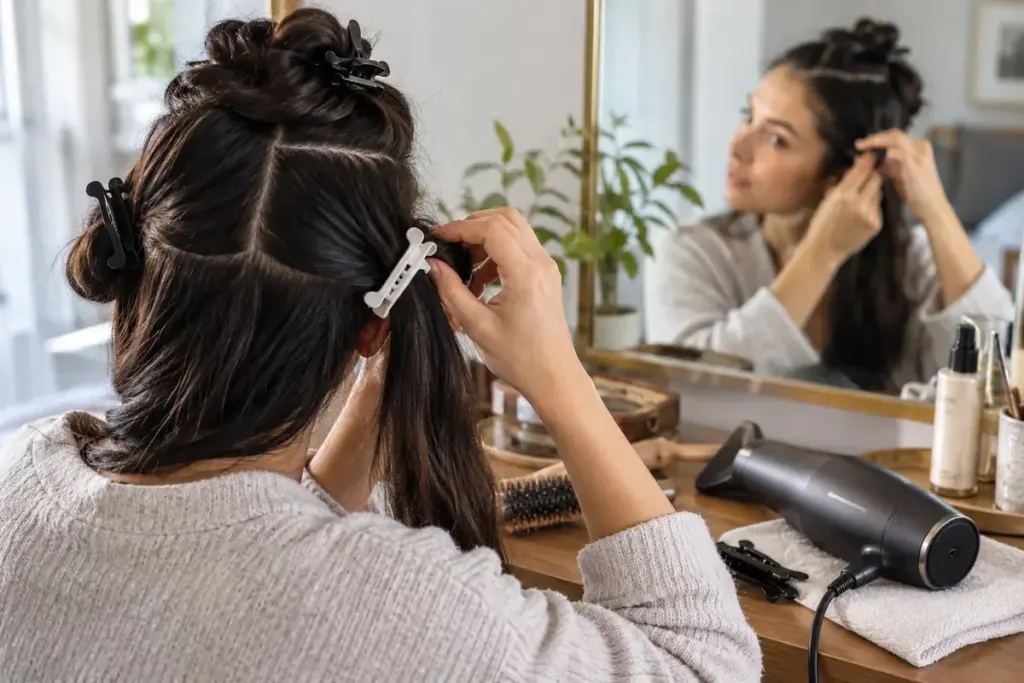
A home blow-dry can become a loop: dry the visible top layer, discover damp hair underneath, then pass over the top again while trying to reach it. Dividing the hair before starting makes the work easier to see and organise.
The American Academy of Dermatology’s styling advice discusses limiting heat-related damage and adapting handling to hair type. Sectioning is a practical organisation method, not a guarantee against damage. Follow your tool’s instructions and choose a routine appropriate for your texture and condition.
Make sections you can actually control
Begin with manageable divisions rather than copying a fixed number from a tutorial. Hair length, density, and your reach all matter. Clip unused sections away without pulling tightly, and keep a clear distinction between the area you are working on and the area already finished.
For a first trial, work in a consistent order, such as lower sections before upper ones. If a section is too large to handle comfortably with your brush and dryer, divide it again. A smaller section should make the movement easier; it should not become an excuse to hold heat on one spot for longer.
Pause if your arms become tired or you lose control of the tool. Keep the dryer away from water, and stop if the scalp feels uncomfortable. A stylist can help adapt the technique when hair is fragile, heavily processed, or difficult to manage without tension.
After the session, note where the process became awkward: clips slipping, sections getting mixed together, or damp roots hidden beneath finished lengths. Adjust that part next time. The useful result is a repeatable sequence that fits your own hair, not a complicated salon diagram that you cannot comfortably follow at home.