
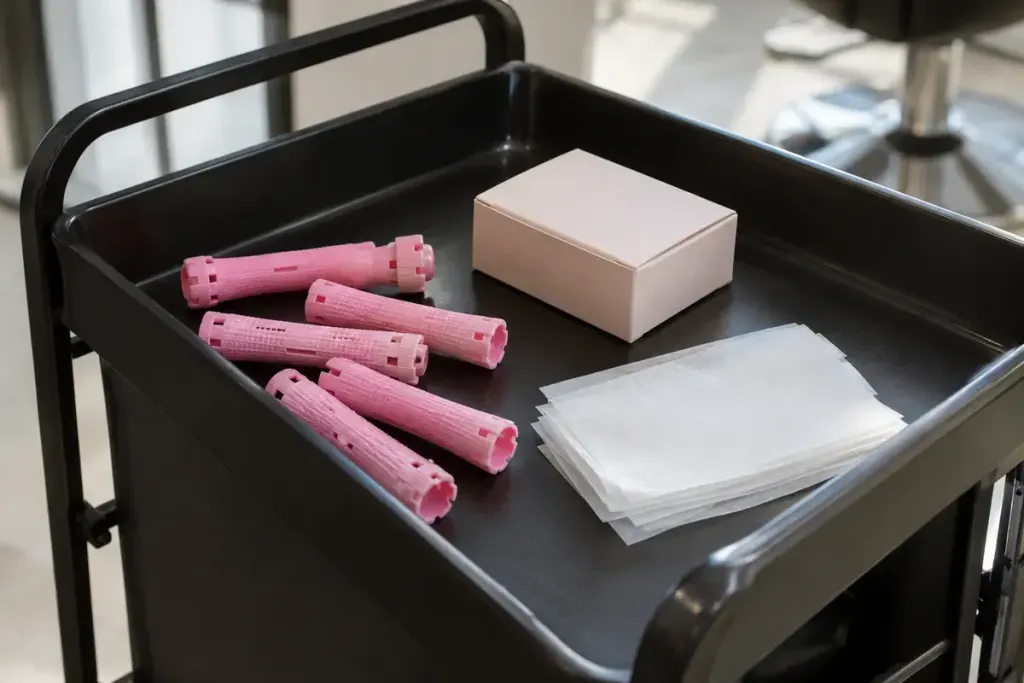
During a salon perm, the stylist may place a thin paper around the ends of a hair section before winding it onto a rod. It is a small part of the service, but it helps make the handling of those ends more controlled.
End papers sit with the hair during wrapping. Product specifications matter: for example, Graham’s Truwave paper description identifies absorbency and wet strength as relevant properties. Ordinary household paper is not automatically an equivalent salon material.
The paper is one part of a larger choice
A tidy wrap is not a guarantee that a perm is suitable for your hair or will reproduce a reference photograph. Rod size, sectioning, wrapping method, product choice and the condition of the hair all belong in the consultation.
Sally Beauty’s consultation guidance emphasises matching the formula and wrapping approach to the hair and desired result. That is a better starting point than choosing a service because someone else used the same size rod.
Show the stylist what you mean by “curl”
Bring a photograph that shows the overall shape you like, then explain which part matters: a bend at the ends, fuller movement through the lengths, or a more defined curl pattern. Ask what the result would look like with your usual drying and styling routine.
Describe previous colouring, lightening, straightening and other chemical services accurately. If you cannot remember a product or date, say what is uncertain rather than filling the gap with a guess.
A useful question about the paper is simple: “How are you protecting and controlling the ends in this wrap?” The answer should fit the actual service rather than turn into a promise that paper alone prevents damage.
Leave with the salon’s written aftercare directions and a clear contact if the result or scalp comfort raises concerns. This is an explanation of a salon tool, not instructions for carrying out chemical processing at home.