
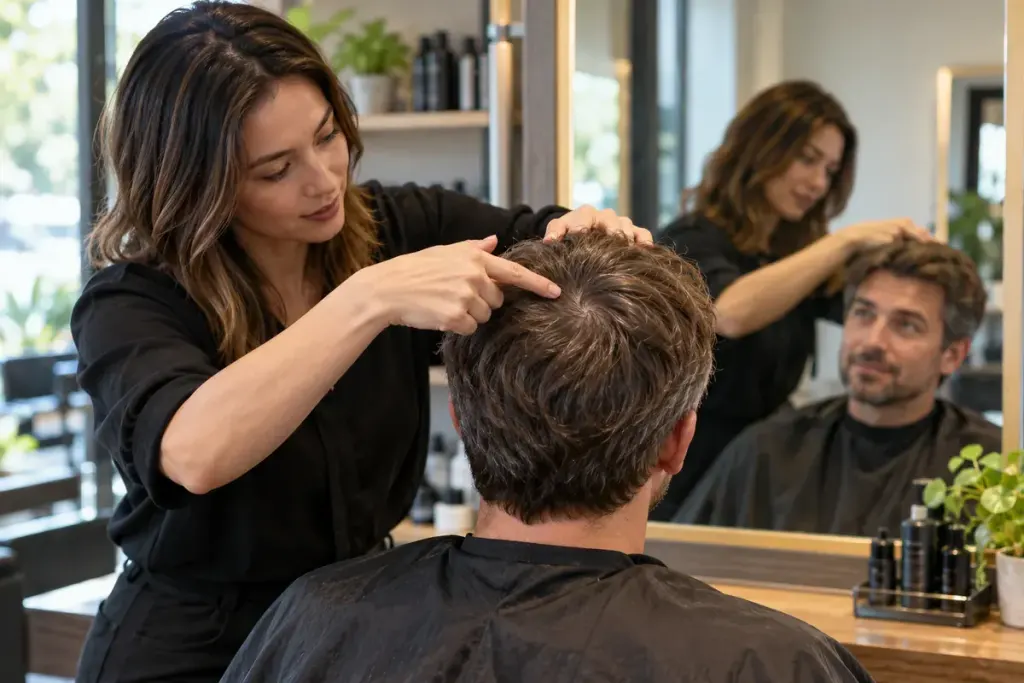
The reference photograph shows a neat, flat crown. Your own hair rises in a small spiral at the back of the head, especially after a shorter cut. Show that section to the stylist before washing, while its natural growth pattern is still easy to see.
A cowlick is not simply evidence that you have brushed badly. Hair growing in a particular direction can return to that pattern when a styled finish relaxes. A cut can work with the behaviour, but a photograph of somebody else’s hair does not show how your own will settle.
Show the ordinary result as well as the target
Bring a picture taken on a normal day, particularly if the troublesome section behaves differently after sleep or after air-drying. Explain which part is inconvenient: a short crown standing up, a visible gap around the swirl or a section that lifts again as soon as it dries.
Hair educator Sam Villa discusses growth patterns and the length left at the crown as practical cutting and styling considerations. His guidance is a reminder to assess the actual pattern rather than promise that any chosen shape will lie flat by itself.
Ask what the shorter version will do
Removing length also removes some of the hair’s weight. Before requesting a much shorter area, ask the stylist how that particular section is likely to behave. There may be several workable options: retain more length at the crown, blend the surrounding shape differently, or choose a style that makes the lift less conspicuous.
For example, a low-maintenance cut for someone who usually air-dries may need a different compromise from a style maintained with a daily blow-dry. Neither is inherently better. The important point is to choose with the actual morning routine in view.
Before leaving, ask to see the relevant styling movement at a comfortable heat and pace, and practise describing it back. Avoid pulling hard or holding heat against the scalp to force a stubborn section into place.
Take the reference photo as a conversation about shape. The most useful result is one you understand well enough to manage after the salon finish has gone.